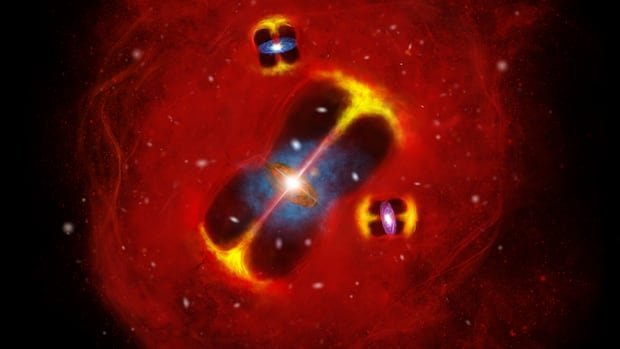

A group of global scientists, led by an astrophysicist from the University of British Columbia, has identified a young galaxy cluster emitting hot gas at a rate five times higher than previously believed possible. This groundbreaking finding has stirred excitement among astrophysicists, potentially reshaping our understanding of the early universe post-Big Bang.
Published in the renowned Nature journal on Monday, the study, involving over two dozen researchers worldwide, focused on the galaxy cluster known as SPT2349-56, located approximately 12 billion light years away. UBC’s Dazhi Zhou, a PhD candidate, spearheaded the research and uncovered a significant presence of hot gas in the intergalactic space.
Zhou noted that this detection of intense hot gas at an early cosmic juncture is unprecedented, given the cluster’s youthful age of merely 1.4 billion years post-Big Bang. Describing it as a significant advancement in comprehending the universe’s workings, Zhou highlighted the study’s implications for astrophysical understanding.
James Di Francesco, director of the Dominion Astrophysical Observatory near Victoria, emphasized the study’s departure from prior theoretical assumptions regarding the swift heating of galaxy clusters. Contrary to expectations of gradual gas temperature elevation over time due to galactic movements, this particular cluster exhibited a rapid and unexpected heating process, challenging existing scientific paradigms.
The researchers’ utilization of telescopes in Chile enabled them to delve into dark clouds, explore star formation intricacies, and delve into the universe’s primordial era. By employing radio telescopes operating in submillimeter and millimeter wavelengths, the team could precisely gauge the gas temperature despite its vast distance from Earth.
Zhou highlighted the critical role of this research in enhancing our comprehension of modern galaxy clusters and their evolutionary mechanisms. The discovery of the unusually hot gas emission in a young galaxy cluster like SPT2349-56 offers a unique perspective on cosmic evolution, opening new avenues for scientific exploration and understanding.