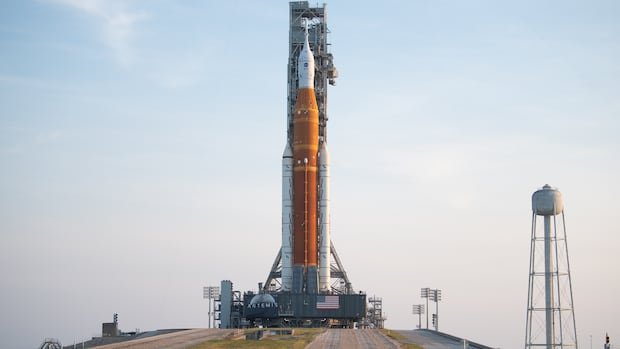

It’s been over half a century since the last human moon landing, but a new era is on the horizon. NASA’s ambitious Artemis program is gearing up for a significant milestone with Artemis II, a mission that will see four astronauts, including Canadian Space Agency astronaut Jeremy Hansen and NASA astronauts Christina Koch, Reid Wiseman, and Victor Glover, orbiting the moon.
Scheduled tentatively for launch on Feb. 6, the mission requires thorough checks of both the rocket and spacecraft before the crew embarks on this historic journey. The highlight of the preparations is the rollout of the colossal 100-meter tall Space Launch System (SLS), set to take place on Saturday.
Expressing excitement for the upcoming events, John Honeycutt, Artemis II mission management team chair, emphasized the historical significance of the mission during a press conference on Friday. The SLS and Orion spacecraft, the living quarters for the astronauts during their 10-day mission, have only been launched once for the unmanned Artemis I mission around the moon in 2022. Now, they are poised to carry their first human passengers.
While Artemis II won’t involve a lunar landing, the crew will engage in lunar surveillance, experiments, and spacecraft testing to prepare for Artemis III, where astronauts are slated to walk on the moon, with a launch no earlier than 2028.
The rollout of the rocket is scheduled for 7 a.m. ET on Saturday, with an estimated journey time of eight to 12 hours to cover the distance to the pad. Charlie Blackwell-Thompson, Artemis launch director, explained that the crew access arm, through which astronauts will board the rocket on launch day, will be retracted, a process taking about 45 minutes.
Following the rocket’s arrival at the pad, additional connections will be established over the subsequent day. The wet dress rehearsal, simulating launch day procedures with propellant loading, will be the next crucial step, with the countdown stopping at T-29 seconds.
Wet dress rehearsals are crucial practice sessions before launch, ensuring all systems function flawlessly. Artemis I underwent four such rehearsals over several months before receiving clearance for launch. When questioned about the proximity of the Feb. 2 rehearsal to the Feb. 6 launch window, Blackwell-Thompson emphasized the lessons learned from Artemis I’s test flight phase, indicating readiness for the upcoming mission.