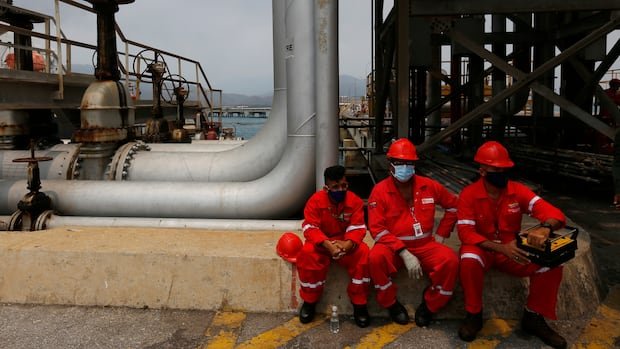

U.S. President Donald Trump’s strategy to assume control of Venezuela’s oil sector and engage American corporations in its revitalization post the capture of leader Nicolas Maduro faces numerous challenges – logistically, legally, and politically.
The bold seizure of Maduro marked the culmination of an aggressive pressure campaign by the Trump administration against Venezuela’s authoritarian ruler, involving months of covert planning and culminating in the most decisive American intervention for regime change since the Iraq invasion of 2003. While Washington has leveled narco-terrorism charges against Maduro, the Venezuelan government has long asserted that the U.S., led by Trump, aims to exploit the country’s abundant natural resources.
Venezuela boasts the largest proven crude oil reserves globally, estimated at around 303 billion barrels, surpassing both Canada and Saudi Arabia and accounting for roughly 17% of the world’s oil reserves. Despite these vast reserves, Venezuela’s oil output has dwindled to less than 1% of global production, plummeting from a peak of 3.5 million barrels daily in 1999 to approximately one million barrels per day today, as reported by OPEC.
Various factors, including nationalization, mismanagement, and corruption, have led to the deterioration of Venezuela’s oil industry, as highlighted by Heather Exner-Pirot, director of energy, natural resources, and environment at the Macdonald-Laurier Institute. The sector, along with other parts of the economy, has been severely impacted by stringent U.S. sanctions imposed since 2015, when Caracas was classified as a national security threat.
The implementation of additional sanctions by Trump in 2017 and 2019 significantly constrained Venezuelan oil exports to the U.S., with recent measures amounting to a complete blockade on the industry, characterized by Secretary of State Marco Rubio as an “oil quarantine.” The repercussions of these actions have been substantial, hindering Venezuela’s economic progress until Washington’s stipulated conditions align with U.S. and Venezuelan interests.
Roxanna Vigil, an international affairs fellow at the Council on Foreign Relations, cautioned that the revival of Venezuela’s oil sector would require substantial time and investment, potentially stretching over a decade and necessitating tens of billions of dollars. The exodus of skilled workers following mass dismissals by then-president Hugo Chavez in response to a 2003 strike has further complicated the industry’s recovery.
Trump’s proposal to involve prominent U.S. oil companies in Venezuela to restore its dilapidated infrastructure and generate revenue for the nation highlights the intricate web of challenges awaiting such endeavors. Beyond the infrastructural hurdles, the political landscape in Venezuela poses formidable obstacles, as emphasized by Francisco Monaldi, director of the Latin American energy program at Rice University.
Monaldi underscored the critical need for foreign investment in Venezuela amid uncertainties surrounding political stability, contract frameworks, and governance dynamics. The prospect of rewriting Venezuela’s constitution to foster a more business-friendly environment and transitioning the economy away from socialism underscores the sweeping transformations required to attract international capital.
In addressing the legality of Trump’s ambitions for Venezuelan oil, legal experts have raised pertinent questions regarding the lawfulness of the recent U.S. operation executed without congressional approval. The implications of international law, particularly the principle of “permanent sovereignty” over natural resources, as outlined in UN Resolution 1803, further complicate the legality of potential U.S. interventions in Venezuela’s oil sector.
While the U.S. stance on Venezuela remains assertive, with Trump signaling intentions to oversee the country, legal uncertainties persist regarding ownership claims over Venezuela’s oil reserves. The historical context of U.S. contributions to Venezuela’s oil industry and assertions of past exploitation by Venezuelan authorities underscore the complex legal and political terrain shaping the future of Venezuela’s oil sector.
Ultimately, the intricate interplay of logistical, legal, and political challenges underscores the formidable hurdles facing Trump’s vision for Venezuela’s oil industry. As stakeholders navigate these complexities, the fate of Venezuela’s oil sector hangs in the balance, subject to a myriad of uncertainties and contentious debates at both domestic and international levels.