
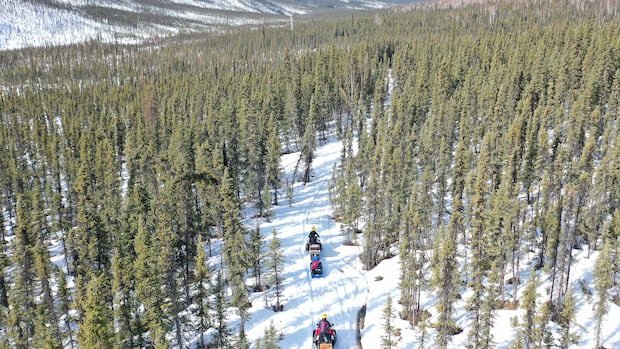

A well-known fact about trees is their capacity to store carbon dioxide, utilizing it for growth. Younger, faster-growing trees are more efficient at absorbing carbon compared to mature trees. However, the carbon stored in trees is released back into the atmosphere when they decay or burn in wildfires.
A group of researchers from the UK, Switzerland, and the Czech Republic has proposed a unique solution to sequester carbon by sinking mature trees from the expansive boreal forest into the deep Arctic Ocean. Their idea aims to lock away carbon for centuries. The scientists conducted a study using computer models to assess the impact of removing specific stands of old trees in fire-prone areas like Canada, Alaska, and Russia. These trees would then be floated down six Arctic rivers, including the Yukon and Mackenzie, before being submerged in the Arctic Ocean.
Simultaneously, new fast-growing trees would be planted to enhance the absorption of carbon from the atmosphere. The researchers believe that the cold, low-oxygen conditions in the Arctic waters would slow down decay, preserving the carbon for thousands of years. The study suggests that by implementing this strategy annually in three regions covering 10,000 square kilometers each, approximately one gigaton of carbon dioxide could be removed from the atmosphere every year.
While the concept shows promise for carbon storage, the practical implementation of such a large-scale project raises challenges. There are energy and carbon emissions implications associated with logging, transporting, and sinking thousands of trees. Additionally, concerns include the impact on ocean floor ecosystems and the disruption to the biodiversity and indigenous communities dependent on these forests.
This initiative is part of a broader discussion on geoengineering solutions to tackle increasing carbon emissions. Other ideas such as injecting sulphur particles into the atmosphere, spraying water on polar ice, and deploying space-based sunshades also present complex challenges and uncertainties. These technologies are being considered as emergency measures if the root cause, fossil fuel combustion, is not effectively addressed.
Ultimately, the focus should be on transitioning to cleaner energy sources like solar, wind, nuclear, and geothermal power. While progress has been made in developing sustainable technologies, there is a need to accelerate their adoption to curb carbon emissions effectively. Transitioning to these clean energy sources is crucial for achieving long-term sustainability and mitigating the impacts of climate change.