
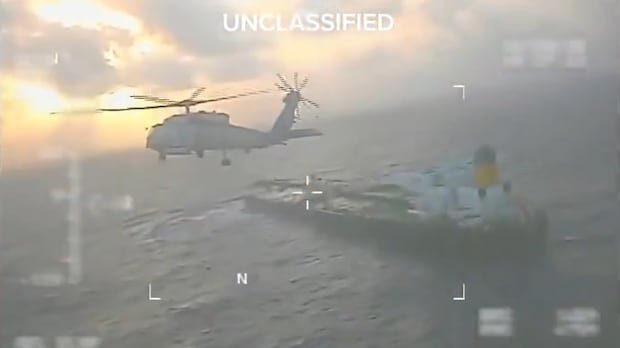

Over the past weekend, Secretary of State Marco Rubio was asked about the potential U.S. government intervention in Venezuela after the recent apprehension of President Nicolás Maduro. Instead of addressing the issue directly, Rubio shifted the discussion towards the enforcement of a U.S. blockade on sanctioned oil tankers. This blockade, initiated by President Donald Trump in December, is being utilized as a tool to pressure for policy changes in Venezuela, according to Rubio’s statements on CBS News’ Face the Nation.
The origin of the blockade dates back to December 16 when Trump announced via his social media platform that Venezuela was completely encircled by a substantial armada, leading to the decision to impose a comprehensive blockade on all sanctioned oil tankers entering or leaving the country. This action was a response to Venezuela’s designation as a foreign terrorist organization due to various illicit activities, including theft of U.S. assets, terrorism, drug smuggling, and human trafficking.
The sanctioned oil tankers targeted by the blockade are listed by the U.S. Treasury Department and are part of an underground network of tankers that transport crude oil into global supply chains through deceptive practices such as altering their identification systems. The Treasury Department highlighted these vessels’ role in supporting sanctionable activities and generating revenue for destabilizing operations.
While Trump referred to the action as a blockade, some officials, like Rubio, prefer to label it as a “quarantine” targeting illegal activities rather than a full-fledged blockade, which is considered an act of war under international law. The distinction is crucial as a blockade implies a wartime naval operation, while a quarantine is focused on law enforcement actions against unlawful vessels.
Currently, only two vessels have been intercepted under the blockade, with one being apprehended before the official announcement. The legality of seizing vessels without proper flags or flying false flags is acknowledged, but experts caution that the blockade’s application raises legal concerns and may not align entirely with traditional blockade practices.
Despite the blockade, some oil tankers have managed to evade interception by masking their locations or disabling transmission signals. This evasion has allowed several sanctioned ships to continue their operations, potentially undermining the intended impact of the blockade on Venezuela’s oil exports and economy.
The blockade’s repercussions on Venezuela could be severe, as the country heavily relies on oil exports for revenue. With the blockade disrupting oil shipments, Venezuela’s state-owned oil company, PDVSA, has faced challenges in maintaining production levels. If the blockade persists, it could result in significant disruptions to Venezuela’s oil production, affecting its economy profoundly.