
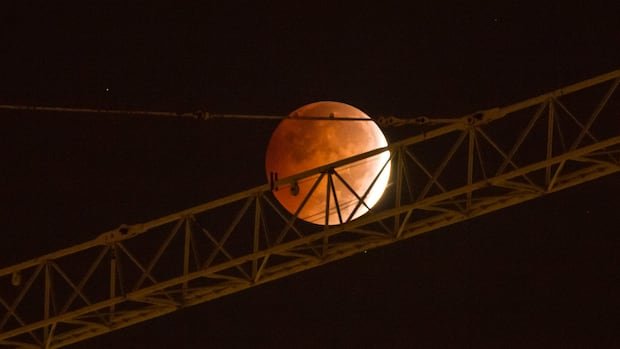

In the early hours of Tuesday morning, a total lunar eclipse will be visible across Canada as the moon passes through Earth’s shadow. The visibility of the eclipse will vary depending on the location within the country.
Residents in far Western Canada, particularly along the coast of B.C. and into Yukon, will have the opportunity to witness the entire eclipse. On the other hand, in the Prairie provinces, the eclipse will not be fully visible as the moon will have set in the western sky during the event. In parts of Atlantic Canada, the eclipse will only appear as a partial eclipse.
To observe the eclipse, individuals will need to wake up early or stay up late, as the event will occur during the early morning hours. Lunar eclipses differ from solar eclipses as they unfold over several hours, progressing through various phases.
Initially, the moon will pass through Earth’s faint outer shadow known as the penumbra, where any changes in the moon’s brightness are hardly noticeable. Subsequently, the moon will enter Earth’s darker inner shadow, the umbra, leading to the partial phase where a section of the moon may seem to vanish or dim.
During a total lunar eclipse, the entire moon enters the umbra, resulting in a striking reddish or orange hue due to Earth obstructing direct sunlight. This phenomenon is often called a “blood moon” as the moon’s color is a result of sunlight filtering through Earth’s atmosphere, with shorter wavelength colors like blue scattering more easily than longer wavelength colors like red.
Factors such as atmospheric dust, like after a volcanic eruption, can impact the eclipse’s appearance, potentially making it appear darker. The eclipse’s timings and phases can be checked on TimeandDate to prepare for the event.
Paul Delaney, a professor emeritus of physics and astronomy at York University, advises eclipse enthusiasts to dress warmly for the chilly weather and consider the moon’s positioning for photography opportunities. Totality during the eclipse will be limited by moonset, and capturing the moon low on the horizon can lead to intriguing shots.