
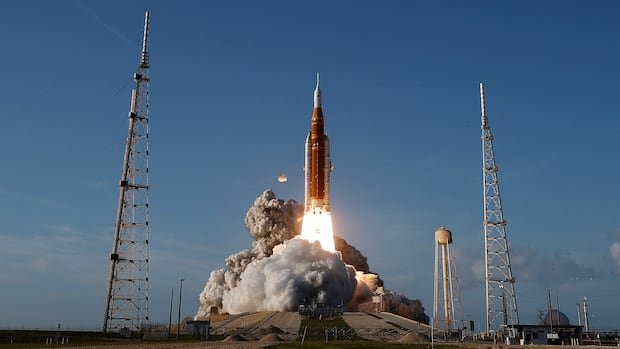

A team of four daring astronauts, including Jeremy Hansen from the Canadian Space Agency and NASA’s Reid Wiseman, Victor Glover, and Christina Koch, are embarking on a 10-day journey to the moon. The launch took place at 6:35 p.m. ET from the Kennedy Space Center amidst a clear blue sky, with spectators lining Florida’s Space Coast to witness the historic event.
After a hiatus of 54 years, NASA is resuming crewed missions to the moon, as stated by NASA administrator Jared Isaacman. The crew, known as Artemis II, will spend a day in Earth’s orbit before igniting the main engine to propel them towards the moon, marking a distance milestone of approximately 405,000 kilometers into space.
During the mission, the astronauts will conduct various tests aboard the Orion spacecraft. Key objectives of Artemis II include testing Orion’s maneuverability and performing a series of experiments to study the effects of space travel on the human body.
The crew will orbit Earth for about 25 hours, testing the interim cryogenic propulsion stage (ICPS) before heading towards the moon. Upon reaching the moon, the crew will capture images of the moon’s far side, conducting experiments and testing communication systems using NASA’s Deep Space Network.
The astronauts will engage in a range of activities during the mission, including a CPR demonstration in zero gravity, testing radiation shielding, and practicing manual piloting of the spacecraft. The mission aims to pave the way for future lunar exploration, with plans for Artemis IV to return astronauts to the moon’s surface by 2028.
Throughout the journey, the astronauts will undertake various experiments and tests to advance space exploration and pave the way for future lunar missions under NASA’s Artemis program.