
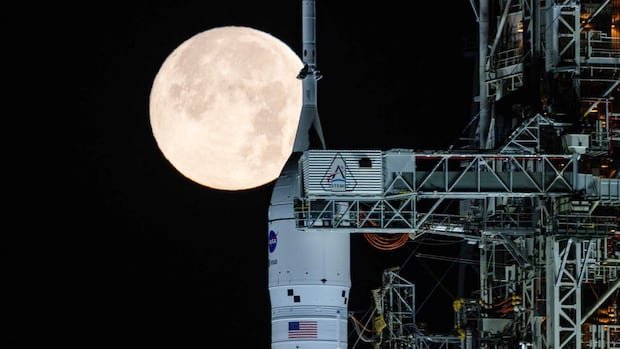

Lunar rocks brought back by Apollo astronauts over 50 years ago are shedding new light on the moon’s enigmatic magnetic field, as per scientists’ recent findings. The upcoming retrieval of samples by NASA’s Artemis program is anticipated to provide further insights. Four Artemis astronauts, including Canadian Jeremy Hansen, are set to embark on a significant test flight to orbit the moon, potentially launching as soon as April from Kennedy Space Center following delays. After encountering setbacks, their Artemis II moon rocket and Orion spacecraft were transported back to NASA’s Vehicle Assembly Building for maintenance.
Research conducted by University of Oxford scientists in the UK proposes that although the moon’s magnetic field was generally weak throughout most of its history, it experienced periods of intensified magnetic activity surpassing Earth’s levels briefly around three to four billion years ago. These findings have been published in the journal Nature Geoscience.
Magnetic fields play a crucial role in shielding against harmful cosmic rays and the sun’s radiation, as observed on Earth. The study revealed brief episodes of significantly high magnetic field strength on the moon, lasting up to 5,000 years or even just a few decades, triggered by the melting of titanium-rich rocks deep within the lunar surface, according to lead author Claire Nichols.
Previously, scientists speculated about sustained strong magnetic fields on the moon based on analyses of rocks brought back by the Apollo missions from 1969 to 1972. With Artemis astronauts focusing on exploring the moon’s south polar region instead of the low-latitude lava plains visited during the Apollo era, the new samples are anticipated to offer a deeper understanding of the moon’s ancient magnetic characteristics.
By examining earlier measurements of the Apollo samples, Nichols and her team identified a correlation between high titanium levels and preserved evidence of heightened magnetic activity. Apollo 11 and Apollo 17 rocks, from the first and final moon landings, were particularly rich in titanium. Nichols emphasized the significance of this discovery, stating that magnetic field activity on the moon could fluctuate more dynamically than previously assumed.
The researchers highlighted that the Apollo samples, sourced from regions abundant in titanium due to volcanic eruptions, may not fully represent the broader moon composition. Future Artemis missions aim to study ancient rocks near the moon’s south pole, where shaded craters are believed to harbor water ice.
Nichols emphasized the importance of understanding the moon’s magnetic shielding history in relation to planetary habitability.