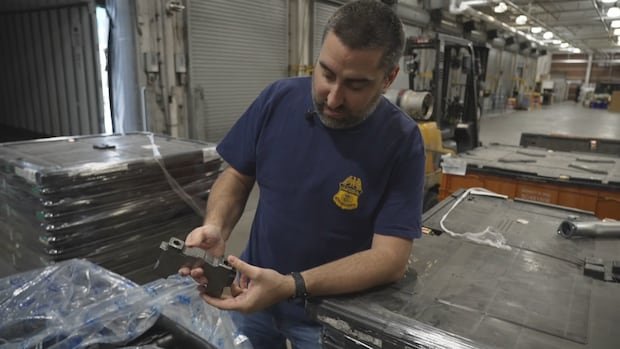

Amidst North America’s busiest border crossing, a warehouse houses skids of automotive parts awaiting inspection by U.S. Customs and Border Protection. These parts, arriving in the U.S. from Canada via the Ambassador Bridge in Windsor, Ontario, are subject to scrutiny by import specialist Marc Ballelli. Ballelli recently flagged a steel tube misclassified as an auto part, highlighting the significant impact of proper classification on tariffs. While steel incurs a 50% tariff, Canadian-made auto parts are tariff-exempt.
The misclassification can lead to financial penalties in addition to applicable tariffs, causing unexpected financial strains on companies. Canadian businesses, grappling with tariffs, now face heightened paperwork requirements, once a routine task but now a top priority for senior staff. Kaycee Vasudeva, owner of Ultra-Form Manufacturing, attributes job losses and new roles in his company to the tariff-induced economic slowdown, emphasizing the mounting paperwork challenges.
The intricate process of determining product classification for tariff purposes at the border has become a full-time endeavor for companies like Ultra-Form Manufacturing. The increased scrutiny by customs officials on both sides of the border has necessitated meticulous attention to detail in customs paperwork to avoid costly errors. With the CBP enforcing tariffs more rigorously, companies are adjusting to the new reality of heightened border regulations.
While the volume of trade penalties remains stable, the amount recovered has surged significantly, underscoring the CBP’s stricter enforcement. Trade experts note that Canadian companies shipping to the U.S. have shifted focus to accurately valuing products to reduce tariffs and ensure compliance with customs regulations. The heightened scrutiny by customs officials signals a departure from the past lax environment companies operated in, necessitating a shift towards greater compliance and transparency in cross-border trade practices.