
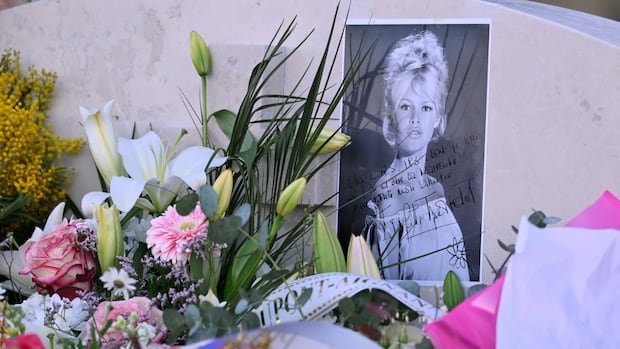

Brigitte Bardot’s final rites took place on Wednesday, featuring a private ceremony and a public tribute in Saint-Tropez, the renowned French Riviera town where she resided for over fifty years post her departure from the limelight of the film industry during the pinnacle of her career.
The prominent animal rights advocate and advocate of far-right ideologies passed away on December 28 at the age of 91 at her residence in southern France following a battle with cancer. Her spouse, Bernard d’Ormale, disclosed in an interview with Paris Match magazine issued on Tuesday that she succumbed to the illness after two surgeries. He mentioned, “She remained conscious and committed to animal welfare until her last moments.”
During the funeral procession, residents and fans paid their respects as Bardot’s casket, once the subject of countless photographs and a quintessential screen goddess of the 1960s, was carried through the town’s narrow streets. The service commenced at the Notre-Dame-de-l’Assomption Catholic Church with a rendition of Maria Callas performing “Ave Maria,” attended by Bardot’s family, including her husband, son, and grandchildren, along with guests invited by the family and the Brigitte Bardot Foundation dedicated to animal protection.
Expressing the profound sorrow felt by many, Max Guazzini, a close friend and the general secretary of her foundation, delivered a heartfelt message to the mourners. Hundreds of individuals congregated in the small town to witness the farewell through large screens set up at the port and two plazas.
Saint-Tropez had always been Bardot’s sanctuary from the fame that once propelled her into the global spotlight. She was laid to rest discreetly at a cemetery overlooking the Mediterranean Sea, joining other notable cultural figures, including filmmaker Roger Vadim, her first husband, who directed her breakthrough film “And God Created Woman,” propelling her to international stardom.
Having settled in her coastal abode, La Madrague, many years ago, Bardot bid adieu to the film industry in 1973 at the age of 39, concluding a successful career that spanned over two dozen films.
In later years, although she retreated from acting, Bardot remained a prominent and sometimes contentious public figure due to her extensive involvement in animal rights causes and her association with far-right politics. Her criticism of the seal hunt in Newfoundland drew backlash for disregarding Indigenous traditions, and she faced legal repercussions, having been convicted and fined multiple times in French courts for inciting racial animosity, stemming from her opposition to the Muslim practice of sheep slaughter during annual religious observances.
Acknowledging her controversial stances, Bardot once remarked to The Associated Press, “It’s true that sometimes I get carried away, but when I see how slowly things move forward … my distress takes over.”
[Source](https://www.cbc.ca/news/entertainment/brigitte-bardot-funeral-9.7037065)