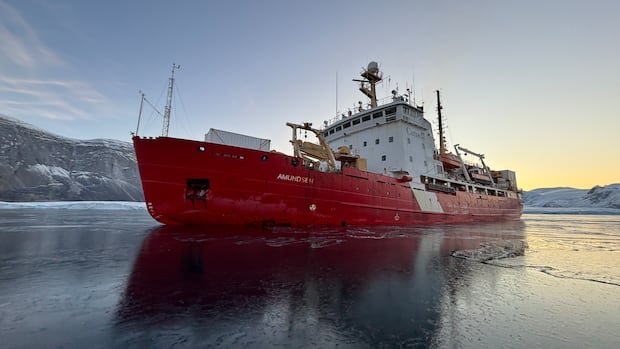

A region in Canada’s High Arctic, including the Queen Elizabeth Islands and western Tuvaijuittuq, has long intrigued scientists due to its enigmatic nature. Known for having year-round sea ice, this area has been historically challenging to explore due to the thick ice cover. However, the melting of sea ice has created an opportunity for a Canadian research icebreaker to navigate through these once-inaccessible passages for the first time.
David Babb, a research associate at the University of Manitoba’s Centre for Earth Observation Science, highlighted the changes in the area, noting the loss of ice and the increased navigability of the waters. Recently, scientists from Fisheries and Oceans Canada (DFO) and the University of Manitoba embarked on a month-long research expedition aboard the CCGS Amundsen to study Arctic sea ice. This mission marked the first extensive oceanographic research venture to reach this specific region of the Canadian Archipelago.
During the expedition, Babb identified two types of ice prevalent in the Arctic: seasonal ice, which forms over a single winter and is relatively thin, and multi-year ice, which thickens over multiple winters. He observed a shift towards more seasonal ice and less multi-year ice in the area. The Arctic’s rapid warming, estimated to be four times faster than global averages, has raised concerns about the future of sea ice in the region, with some projections suggesting its disappearance within the coming decade.
The ability of an icebreaker to penetrate these once-impenetrable sea ice regions serves as a stark indicator of climate change’s impact. Despite the concerning changes, it presents an invaluable opportunity for scientists like Babb to enhance their understanding of this lesser-explored part of the Arctic and make informed projections about its future implications.
On the research vessel, Babb was initially surprised by the scarcity of thick ice, fish, and organic matter in the Arctic waters, particularly around Nansen Sound and Greely Fjord. Although they encountered heavily melted sea ice, the discovery of thicker ice further south provided some reassurance. The team’s outreach to communities like Grise Fiord and Resolute Bay emphasized the interconnectedness of the High Arctic’s environmental changes with downstream impacts on larger fisheries operations.
Following the expedition, the researchers engaged with the local community at Resolute Bay’s Qarmartalik School to share their findings and exchange insights. Students like Kupaaq Idlout learned about mercury presence and phytoplankton in the ocean, highlighting the importance of community involvement in monitoring environmental changes. Teacher Rhonda McKenzie echoed community concerns about shifting ice conditions and emphasized the value of integrating traditional knowledge from elders into scientific research efforts.
Babb emphasized the importance of community participation in measuring ice thickness and expressed hope for their involvement in future expeditions to leverage their invaluable observations gained from living closely with the land and water.
Overall, the expedition’s findings shed light on the evolving Arctic environment, underscoring the urgent need for collaborative efforts to monitor and mitigate the impacts of climate change on this fragile ecosystem.