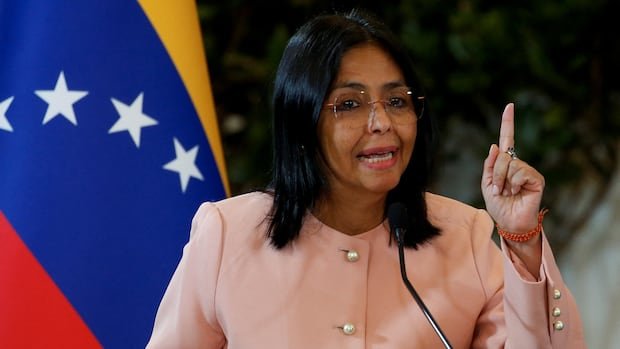

Delcy Rodríguez has assumed leadership in Venezuela as the interim president following Nicolás Maduro’s capture by the United States in a military operation and subsequent transfer to New York City to face criminal charges. Venezuela’s high court mandated Rodríguez to take on the role of interim president, a decision supported by the country’s military, and she was officially sworn in on Monday. Rodríguez, who previously served as Maduro’s vice-president and held key roles in Venezuela’s economy and intelligence services, expressed her concerns for the Venezuelan people amidst recent events during her inauguration.
Having a background in law and politics, Rodríguez has been associated with the socialist movement initiated by Maduro’s predecessor, Hugo Chávez. She has held various governmental positions under Chávez and later worked closely with Maduro, assuming a prominent position as his potential successor. Rodríguez has also fostered connections with U.S. Republicans in the oil and financial sectors, advocating against U.S.-led regime changes. Her relationship with the military, a significant political entity in Venezuela, has been described as transactional by experts.
The sudden shift in leadership came as a surprise when U.S. President Donald Trump acknowledged communication between U.S. Secretary of State Marco Rubio and Rodríguez, signaling a potential collaboration. Despite initial tensions with the U.S., Rodríguez later extended an invitation for cooperation to foster mutual development within the framework of international law. The future actions of the interim president remain uncertain, with Trump emphasizing the importance of compliance with U.S. interests.
The current situation in Venezuela has raised concerns among the opposition and international observers, as the country navigates through a period of political transition. With the constitution mandating an election within 30 days in case of the president’s permanent unavailability, the appointment of Rodríguez as the interim leader has sparked discussions about the country’s political trajectory. The unease in Venezuela is palpable, with citizens preparing for potential instability by stocking up on essential supplies.
As the nation braces for further developments, the political landscape in Venezuela remains volatile, with questions looming over the interim leadership’s intentions and the potential outcomes of the ongoing power struggle.