
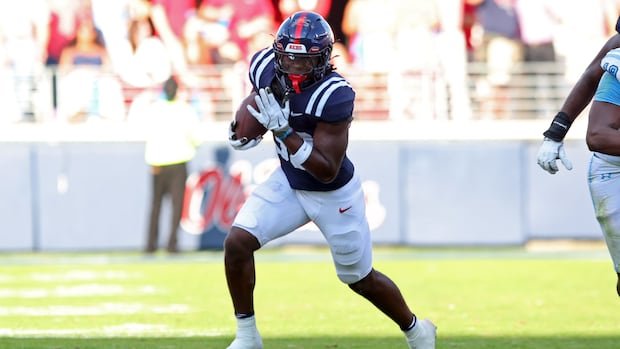

Canadian football player Shekai Mills-Knight, a freshman running back at Ole Miss, is set to showcase his skills in a crucial NCAA football semifinal against the Miami Hurricanes on Thursday night in Glendale, Arizona. However, his journey to this point began a decade ago in a Montreal suburb when, as a 9-year-old, he faced a challenge due to his weight.
Living in Dollard-Des-Ormeaux, Mills-Knight was deemed 11 pounds overweight for his age group’s weight restrictions in a local little league, preventing him from playing as a running back and leading to his team forfeiting several wins. Despite his family asserting that his weight was recorded incorrectly at 111 pounds instead of the actual 101 pounds, the league upheld the ruling, impacting his early football experience.
Fast forward to the present, Mills-Knight has excelled in various sports throughout his high school career at Baylor School in Tennessee. Now at Ole Miss, the 6-foot-3, 220-pound athlete has shown promise on the field. His path from the weight controversy as a child to collegiate success highlights his perseverance and talent.
Amidst the evolving landscape of college football in the U.S., characterized by shifting player contracts, loyalty dynamics, and debates on amateurism, Canadian players like Mills-Knight stand out for their contributions on the field. With success stories like his, along with a growing number of Canadian footballers making their mark in the NCAA and NFL, the sport continues to attract attention and support from fans on both sides of the border.
As the College Football Playoff unfolds and the spotlight shines on athletes like Mills-Knight, the Canadian presence in high-level football serves as a testament to the sport’s global appeal and the opportunities it offers to talented players. In a world where sports narratives blur the lines between reality and drama, the rise of Canadian talents in American college football adds an intriguing subplot to the ever-evolving landscape of the game.