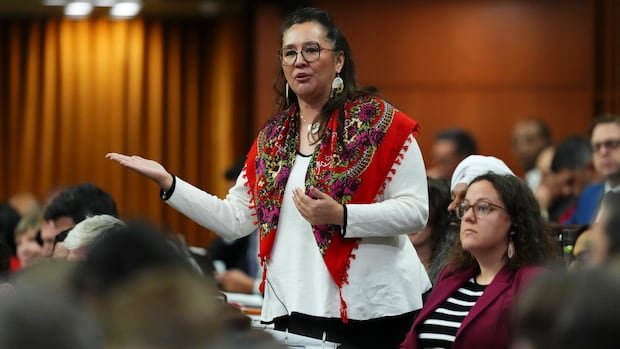

Prime Minister Mark Carney’s administration has introduced a new initiative exceeding $35.5 billion to ensure the connection of First Nations children with their communities, culture, and families. This proposal, although lower than the $47.8 billion put forth by former Prime Minister Justin Trudeau’s government over a decade, spans a shorter timeframe and includes a significant feature: a $4.4 billion yearly commitment starting in 2033-34 following the initial investment of $35.5 billion.
Indigenous Services Minister Mandy Gull-Masty disclosed the plan details to CBC News before the official announcement in Ottawa on Monday, coinciding with the submission of the government’s strategy to revamp the on-reserve child welfare system at the Canadian Human Rights Tribunal.
Gull-Masty emphasized the urgency of addressing the issue promptly, stating, “Every day spent negotiating agreements or addressing discrimination legally means another day a child remains in care.” She stressed the importance of creating a system where children in care are surrounded by their community, known individuals, and those who will impart cultural, identity, and language teachings.
In addition to the government’s proposal, the tribunal is reviewing an alternative plan presented by a coalition of First Nations chiefs and child advocates, known as the National Children’s Chiefs Commission, in collaboration with the First Nations Child and Family Caring Society. This initiative was instigated by the Assembly of First Nations (AFN) after rejecting the Trudeau government’s previous offer due to concerns about the limited duration and annual reviews of the allocated funds.
The submissions come nearly a decade after a landmark ruling that found Ottawa guilty of racial discrimination by underfunding First Nations Child and Family Services. They also follow a joint human rights complaint lodged by the AFN and the Caring Society in 2007.
If the tribunal approves Ottawa’s plan, Gull-Masty assured that the allocated $35.5 billion will be safeguarded through a legal order to prevent alterations by future administrations and will be promptly accessible. The minister clarified that the previously proposed $47.8 billion remains available as the government has been utilizing these funds to cover services, costing approximately $4.4 billion annually.
The government is advocating for a national reform strategy while seeking regional agreements with First Nations entities to customize service delivery and funding based on unique community circumstances. Gull-Masty emphasized the need for community-led decision-making to establish care standards tailored to each community’s identity.
Meanwhile, Blackstock advocated for national minimum standards in First Nations child and family services with regional adaptations to hold the federal government accountable for ensuring consistent care nationwide. She underscored the necessity of systemic solutions to prevent future discrimination on a nationwide scale.
Gull-Masty reported that seven regions have displayed interest in negotiating regional deals with the government. She aims to finalize all regional agreements by September 2026 and implement them by April 1, 2027, with communities failing to engage falling under the national agreement.
For Gull-Masty, the mission hits close to home as she previously served as the first female grand chief of the Cree Nation Government in Quebec before entering federal politics. She expressed a personal connection to the cause, citing her experiences witnessing children in her family enter care and the challenges of aiding them through such circumstances.
Despite the multiple plans under consideration, Gull-Masty expressed a willingness to collaborate with the National Children’s Chiefs Commission and the Caring Society, emphasizing the importance of unity in addressing the issue rather than debating individual proposals.