
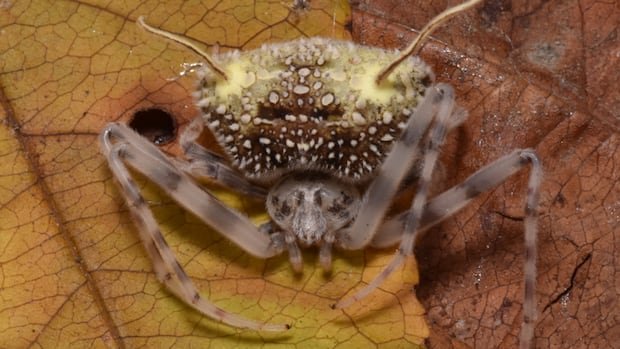

In a surprising encounter during an Amazon rainforest tour in August 2025, herpetologist Alexander Bentley prodded what seemed to be a deadly parasitic fungus covering a spider, only to find the spider alive underneath. This spider displayed tubercles on its abdomen, resembling the aftermath of a cordyceps infection, known for its “zombie fungus” characteristics.
Initially mistaken for a cordyceps-infected spider that miraculously survived, further examination revealed it to be a novel arachnid species mimicking fungus like cordyceps, potentially for hunting or defense purposes. The discovery, detailed in Zootaxa, has sparked excitement among scientists, though some remain skeptical of the spider’s mimicry behavior.
Consulting the citizen-science platform iNaturalist, Bentley enlisted the help of colleague David Ricardo Díaz-Guevara to confirm the spider’s uniqueness. Through meticulous morphological analysis, Díaz-Guevara identified the spider as a new species, named Taczanowskia waska.
This groundbreaking finding, facilitated by platforms like iNaturalist, has intrigued experts like mycologist Monika Fischer, who emphasized the impact of citizen science. The spider’s mimicry of cordyceps raises theories of aggressive hunting tactics or defensive strategies against predators, shedding light on the spider’s evolutionary adaptations.
While the spider’s resemblance to cordyceps stalks is striking, the true purpose of its elaborate features remains a subject of debate among experts like Andrew Swafford. Despite uncertainties, Bentley considers this discovery the most extraordinary encounter in his rainforest explorations, emphasizing its rarity and uniqueness among his scientific endeavors.