
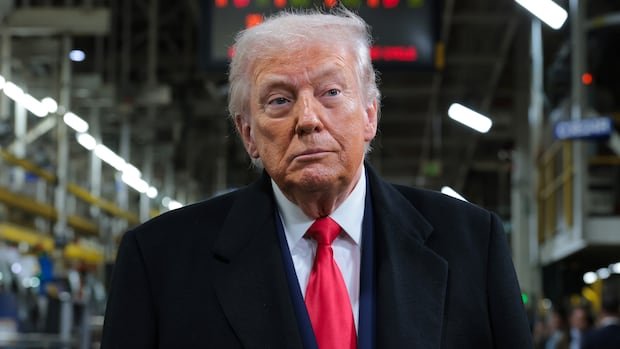

U.S. President Donald Trump dismissed the significance of the Canada-U.S.-Mexico Agreement (CUSMA) on Tuesday, stating that it holds no real advantage for the U.S. but is desired by Canada. Trump emphasized the importance of bringing manufacturing operations back to American soil. The Detroit Three automakers heavily rely on supply chains that involve substantial parts production in Mexico and Canada, with hundreds of thousands of vehicles being produced annually in both countries.
Last year, major automakers urged the Trump administration to extend CUSMA, citing its crucial role in American auto production. The American Automotive Policy Council, representing the Detroit Three automakers, highlighted that CUSMA enables U.S.-based automakers to compete globally by integrating regionally, resulting in significant efficiency gains and billions of dollars in annual savings.
During a visit to a Ford factory in Michigan, Trump expressed that the U.S. does not require cars manufactured in Canada or Mexico, emphasizing the shift towards manufacturing within the U.S. Stellantis previously warned that under certain tariffs, U.S. vehicles complying with North American content rules could lose market share to Asian imports, impacting American automotive workers.
CUSMA is undergoing a review this year to determine its future, with discussions set to commence among Canada, the U.S., and Mexico. Canadian Trade Minister Dominic LeBlanc’s spokesperson confirmed that discussions with key sectors of the Canadian economy and labor unions are underway to gather input for the joint review of CUSMA. Trump’s recent comments have set a familiar tone as negotiations between Canada and the U.S. progress.
The CUSMA trade agreement, which replaced NAFTA during Trump’s first term, mandates a joint review after six years. Trump’s previous characterization of the deal as “transitional” and discussions about potentially negotiating separate deals with Canada and Mexico have added uncertainty to the future of the trade pact. Observers suggest that Trump’s remarks may prompt Canada to explore expanding its trade partnerships beyond the U.S.
Meanwhile, Prime Minister Mark Carney is on a trade and investment-focused trip, starting in China and moving on to Qatar and Switzerland to attend the World Economic Forum.