
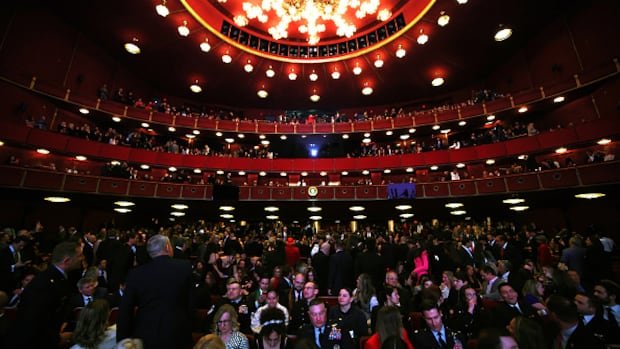

U.S. President Donald Trump revealed plans on Sunday to shut down the Kennedy Center in Washington for a two-year period beginning in July for renovation purposes. This decision marks the latest move by Trump to transform the renowned venue since his return to the White House.
Trump’s announcement, made via social media on Sunday evening, comes after a series of event cancellations following his removal of the previous leadership and the addition of his name to the building. Despite these cancellations, Trump did not address them in his announcement.
The President’s proposal to close the center coincided with the recent screening of a documentary about the first lady, Melania, at the venue. Trump stated that his plan is contingent upon approval from the Kennedy Center’s board, which comprises individuals aligned with his views. Notably, Trump serves as the chairman of the board of trustees.
In his social media post, Trump emphasized that the decision to temporarily close the center is based on advice from numerous respected experts. He described the current state of the center as worn-out, deteriorated, and financially unstable, and expressed his intention to revamp it into a world-class hub for arts, music, and entertainment.
Kennedy Center president Ric Grenell, a Trump supporter, echoed the need for the renovation, asserting that the temporary closure would allow for a more substantial investment in resources and expedite the restoration process.
The Kennedy Center, established as a national cultural institution, was redesignated as a living memorial to President John F. Kennedy in 1964. Since its opening in 1971, the center has served as a prominent platform for various art forms, including the National Symphony Orchestra.
Following Trump’s intervention in the management of the Kennedy Center, several prominent performing arts groups have withdrawn from scheduled performances. Composer Philip Glass, for instance, opted to pull out his Symphony No. 15 “Lincoln,” citing a misalignment of values between the center’s current ethos and the message conveyed by his composition.
Similarly, the Washington National Opera announced its decision to relocate performances away from the Kennedy Center, marking another high-profile departure subsequent to Trump’s involvement in the venue.
In response to the escalating tensions, Rep. Joyce Beatty, an Ohio Democrat and ex-officio trustee of the center’s board, challenged Trump’s authority to rename the Kennedy Center. Beatty criticized Trump’s unilateral actions, highlighting the need for artistic independence and expressing concerns about the future of the center under the current administration.
Since assuming office, Trump has embarked on a series of ambitious projects to revamp various landmarks in Washington, including the Kennedy Center. His initiatives have faced opposition from members of Congress and the Kennedy family, reflecting broader concerns about the preservation of historical and cultural significance amidst the changing landscape of the capital city.