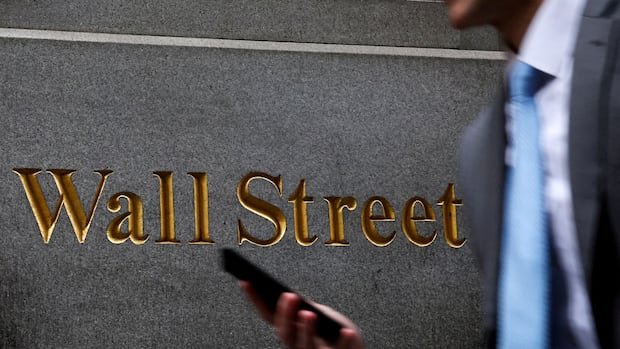

Stocks plummeted during afternoon trading on Wall Street on Tuesday following U.S. President Donald Trump’s warning to impose new tariffs on eight NATO members amid escalating tensions over his efforts to assert American dominance over Greenland. The S&P 500 experienced a significant 2.1% decline, marking its most substantial drop since October. This reaction from U.S. markets was the first opportunity following Trump’s escalation, as they were closed on Monday for Martin Luther King Jr. Day.
The Dow Jones Industrial Average saw a sharp decline of 877 points, equivalent to a 1.8% drop, as of 2:46 p.m. ET. Additionally, the Nasdaq composite suffered a 2.4% slump, mirroring the downward trend witnessed in European and Asian markets. Canada’s primary stock index was also impacted, with the S&P/TSX composite index falling by 340.68 points to 32,750.28.
The market downturn on Wall Street was widespread, predominantly affecting technology stocks, which hold significant sway over market direction due to their substantial valuations. Retailers, banks, and industrial firms also experienced notable declines. Noteworthy companies like Nvidia, Amazon, JPMorgan Chase, and Caterpillar all registered significant drops.
In contrast, companies focusing on consumer staples fared relatively better amidst the market turmoil. Colgate-Palmolive saw a 1.5% increase, while Campbell’s recorded a 1.7% rise. The price of U.S. crude oil climbed by 1.5% to reach $60.34 per barrel, while Brent crude, the global benchmark, rose by 1.3% to $64.76.
Trump’s recent tariff ultimatum involved the imposition of a 10% import tax on goods from several European countries starting in February. The move sparked a negative reaction in European markets, with Treasury yields also seeing an uptick in the bond market. This decision is significant given that the collective imports from European Union nations surpass those from top individual U.S. importers like Mexico and China.
Before the U.S. markets opened, major European markets in Paris, Frankfurt, and London all faced declines exceeding 1%, setting the stage for a second consecutive day of losses. The escalating trade tensions led to a surge in safe-haven assets, with both gold and silver reaching new highs. Gold surged by 3.7%, while silver saw a robust 6.9% increase.
Trump’s aggressive stance on Greenland is tied to his discontent over being overlooked for the Nobel Peace Prize, as revealed in a text message exchange with Norway’s prime minister. This exchange has intensified the standoff between Washington and its allies regarding Trump’s aspirations to control Greenland, a self-governing territory of NATO member Denmark.
The uproar across Europe in response to Trump’s threats has triggered diplomatic activities and discussions on potential countermeasures, including retaliatory tariffs and the probable utilization of the European Union’s anti-coercion instrument. This conflict with Europe unfolds as global leaders convene at the World Economic Forum in Davos, Switzerland.
Analysts anticipate that the new tariff threat may impact the ongoing Davos meeting but predict that tensions will likely ease over time as negotiations progress. The recurring tariff uncertainties have been a persistent concern for the U.S. and global economies since 2024, adding pressure to businesses already navigating high prices and inflation risks.
The Federal Reserve’s task in managing potential inflationary pressures is further complicated by the looming threat of tariffs. Despite implementing rate cuts in 2025 to support the weakening job market, the Fed remains cautious due to inflation persisting above its 2% target. Trump’s tariff strategy, characterized by unpredictability and fluctuations, poses challenges for businesses in planning for the future.