

Shelley Carr had high hopes when she connected with a new acquaintance on Tinder last autumn who shared her passion for art, politics, and theatre. “I’m quite artistic. I enjoy theatre, attending plays, and visiting art galleries, so I was seeking someone similar,” Carr expressed. She felt a rare connection due to their shared interests.
Wanting to assess their compatibility in person, Carr arranged a meetup. However, upon seeing him disembark from the bus in Hamilton for their date, she sensed that the person before her was not the same individual she had been conversing with. The realization set in when her date confessed that the articulate messages she received were crafted by ChatGPT, not him.
The revelation left the 56-year-old Carr stunned. “I’ve encountered various situations, but nothing like this,” she remarked. Carr’s experience highlights how artificial intelligence (AI) is reshaping the landscape of online dating, with differing opinions on its impact.
Many companies are embracing AI tools to enhance the user experience and combat dating app fatigue. Regina Hay, a 24-year-old Torontonian, noticed an increase in AI implementation in dating apps, from profile content to message exchanges. She recounted an incident where her promising chat took a turn when her potential date shared a sophisticated Spotify Wrapped hypothesis that seemed AI-generated.
Hay felt deceived when the individual admitted to using AI, emphasizing her desire for genuine connections over automated conversations. The influx of ChatGPT-generated content and third-party apps like RIZZ is altering the dynamics of online dating, prompting platforms to integrate AI for improved user engagement.
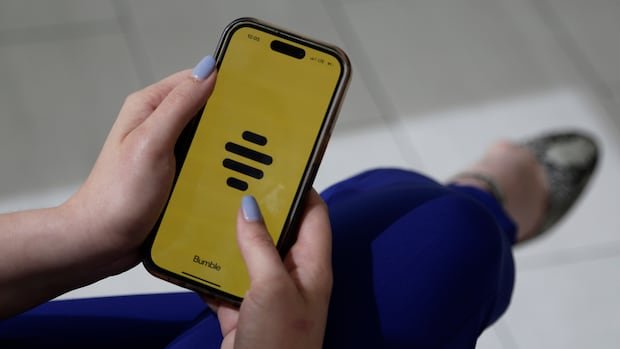
Bumble recently introduced an AI-driven feature offering personalized profile feedback, aiming to enhance user confidence and clarity. Similarly, Facebook’s AI assistant feature assists users in optimizing their profiles beyond conventional criteria like age and education, enabling tailored prompts for better matches.
While these AI tools can be advantageous in refining profiles for increased match potential, they also raise concerns about authenticity and genuine connections. The prevalence of AI-generated content may lead to a homogenized dating pool, diminishing individuality and fostering skepticism among users.
Some platforms, like Keeper.AI, utilize AI as a high-end matchmaking tool, streamlining the matching process by leveraging user-provided data to pair compatible individuals. Jake Kozloski, CEO of Keeper.AI, emphasized the platform’s focus on quality matches to facilitate meaningful connections, contrasting it with traditional dating apps’ hit-or-miss approach.
Despite the efficiency AI brings to matchmaking, critics like Eve Tilley-Coulson fear it may commodify and dehumanize the search for love. While AI aids in finding partners that meet specific criteria, it may detract from the organic and romantic aspects of forming genuine connections.
In essence, AI’s increasing role in online dating offers both benefits and challenges, reshaping how individuals navigate the quest for love in a digitally-driven era.