
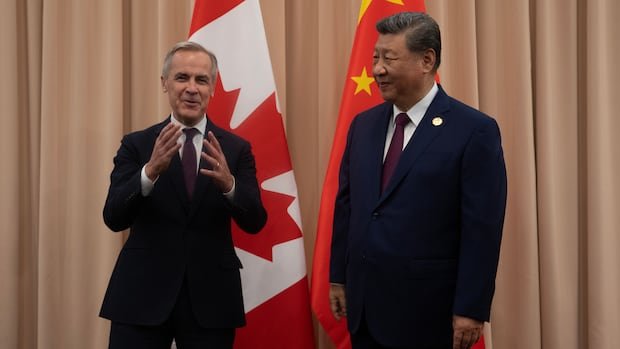

Prime Minister Mark Carney is set to embark on a significant trip to China next week, which marks the first visit by a Canadian prime minister to the country since 2017. The Prime Minister’s Office (PMO) announced that the trip, scheduled from Jan. 13 to 17, will involve meetings between Carney and Chinese President Xi Jinping to discuss various topics such as trade, energy, agriculture, and international security.
Carney expressed that the global trade disruptions have prompted his government to reshape Canada’s economy, moving away from dependency on a single trade partner towards a more robust and resilient structure. This transformation involves forging new partnerships in energy and trade, attracting substantial investments, and creating more opportunities for Canadians.
During the Asia-Pacific Economic Cooperation (APEC) summit in Gyeongju, South Korea, in October, Carney engaged with Xi and accepted an invitation for the upcoming visit. In China, he is scheduled to meet not only with President Xi but also with Premier Li Qiang and other officials. Following his time in China, Carney will head to Doha on Jan. 18 for a meeting with Qatar’s emir, Sheikh Tamim bin Hamad Al Thani. Subsequently, he will proceed to Davos, Switzerland, from Jan. 19 to 21 for the World Economic Forum’s annual meeting, where he will engage with business leaders.
The upcoming discussions between Carney and Xi may touch upon various trade disputes between Canada and China. Notably, Canada imposed 100% tariffs on Chinese electric vehicles in 2024, citing the need to protect its domestic automobile industry. In response, China retaliated with tariffs on Canadian canola seed imports, canola oil, meal, peas, as well as certain pork, fish, and seafood products.
Former diplomat Michael Kovrig highlighted the ongoing efforts to mend relations between Canada and China, acknowledging the challenges that persist. He emphasized the importance of high-level diplomatic engagements like the upcoming meeting between Carney and Xi in resolving disputes and fostering improved relations. Kovrig cautioned against compromising national security or policy autonomy in pursuit of economic gains from China.
Despite these diplomatic efforts, the Opposition Conservatives criticized Carney’s frequent international travels, questioning the outcomes for Canadians and labeling them as ineffective. Conservative Leader Pierre Poilievre’s office criticized the prime minister’s jet-setting as wasteful and called for a focus on reversing what they deemed as detrimental Liberal policies affecting Canada’s resources and economy.
In a related stance, Poilievre has been vocal about his skepticism towards the World Economic Forum, viewing it as a platform for global elites that undermine the working class. He pledged to prohibit ministers or government officials from attending the annual meeting if a Conservative government led by him were in power.