
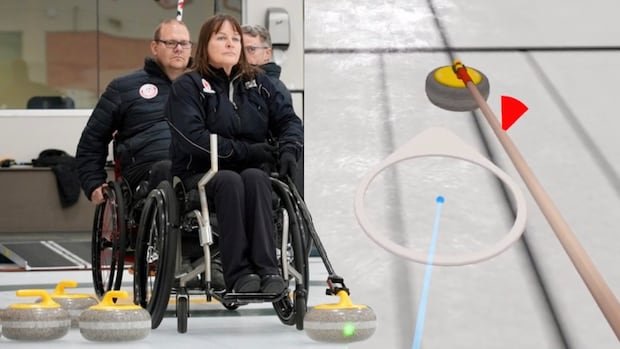

With less than two months remaining until the commencement of the 2026 Paralympic Games in Italy, the Canadian wheelchair curling team is diligently preparing for the event. This year, a virtual reality program developed in Alberta is set to enhance the team’s training and performance in pursuit of the gold medal.
Jennifer Dornstauder, the engineering technical lead of the project, highlighted the uniqueness of the program tailored for seated users, enabling them to visualize their bodies within the virtual simulation. The innovative approach aims to eliminate traditional training constraints, allowing a focus on strategic and tactical training without physical limitations.
The Canadian wheelchair curling team has consistently secured podium finishes at every Paralympics, distinguishing themselves as the only country to achieve this remarkable feat. Embracing innovation has been pivotal in their success.
In wheelchair curling, often referred to as “chess on ice,” the absence of sweeping necessitates a heightened emphasis on strategy to ensure precise shot placements. The integration of technology, particularly virtual reality, is anticipated to elevate the team’s performance by providing a simulated competitive environment for strategic training.
The VR simulation, mirroring the actual competition venue with assistance from Curling Canada’s photos, offers athletes a familiarization advantage. This immersive experience aids in mental preparation and spatial visualization, crucial for optimizing performance within the tournament setting.
The utilization of VR technology in wheelchair curling signifies a significant evolution in the sport’s equipment and strategic approach over the years. Athletes like Gil Dash emphasize the importance of leveraging every available resource to enhance their competitive edge, underscoring the sport’s culture of continuous improvement and adaptation.
The development of the VR program, named “Chess On Ice,” stemmed from a collaborative effort between Red Deer Polytechnic and Curling Canada. The project, initiated following a conversation at an industry conference, culminated in the successful creation of a specialized VR software within a short timeframe. Challenges in recreating realistic ice physics and game dynamics were overcome through iterative collaboration with experts and athletes.
Future enhancements to the VR software include features like a heat map, multiplayer mode, and a functional scoreboard, with the overarching goal of fostering inclusivity and expanding interest in wheelchair curling. The technology holds promise not only in enhancing the performance of current athletes but also in nurturing a new generation of talents and introducing the sport to a wider audience.