
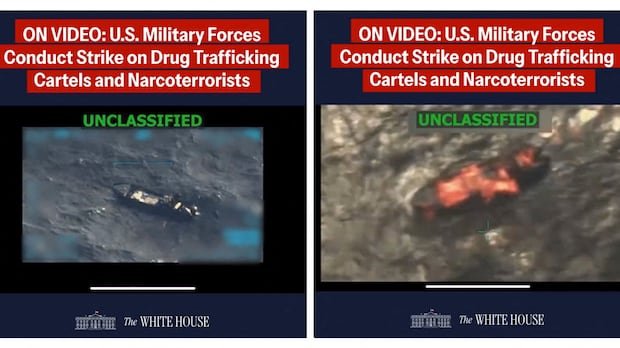

A U.S. military aircraft, which targeted a suspected drug-smuggling boat near Venezuela last autumn, was camouflaged to resemble a civilian plane, a tactic seemingly conflicting with Pentagon guidelines on warfare ethics. The aircraft, part of a clandestine U.S. surveillance fleet, was also equipped with weapons inside the fuselage, deviating from standard military protocol of carrying armaments externally.
Reports on the aircraft’s deceptive appearance, initially disclosed by the New York Times on Monday, were substantiated by two informed sources speaking anonymously to The Associated Press. Pentagon press secretary Kingsley Wilson asserted the military’s utilization of various conventional and unconventional aircraft based on mission demands.
The revelations follow the Trump administration’s aggressive stance towards Venezuela, which commenced with amassing military assets in Latin America and engaging in a series of operations against alleged drug-smuggling vessels, resulting in the deaths of over 115 individuals. These events culminated in a recent high-profile operation capturing Venezuelan leader Nicolás Maduro, who was subsequently extradited to the U.S. to face drug trafficking charges.
In response to these events, the U.S. Senate is set to vote on a war powers resolution this week to restrict further military actions in Venezuela without congressional approval. President Trump has reportedly been actively lobbying Republican senators who supported advancing the resolution, expressing strong opposition to potential constraints on his war powers authority.
The Trump administration has justified the boat strikes by claiming an ongoing “armed conflict” with drug cartels in the region and labeling the boat operators as unlawful combatants. However, military guidelines prohibit military personnel from posing as civilians during combat operations, a practice known as “perfidy,” which is deemed illegal under international laws of war.
U.S. Navy manuals emphasize the risks posed to civilians when military forces disguise themselves as non-combatants, emphasizing the importance of maintaining military honor and adherence to established rules of engagement. Pentagon spokesperson Kingsley Wilson emphasized the rigorous vetting process for aircraft procurement to ensure compliance with domestic and international laws.
The aircraft in question, disguised as a civilian plane, was involved in a strike on September 2, marking the start of a prolonged campaign of U.S. military strikes on suspected drug-trafficking vessels in the region. Congressional inquiries have been launched to address concerns surrounding the military actions, particularly the follow-up strike that allegedly targeted survivors of the initial attack.
Legal experts have raised questions about the legality of the subsequent strike on shipwrecked survivors, citing violations of international laws of war. Calls for the public release of unedited footage of the operation have been made, although Defense Secretary Pete Hegseth has declined to do so.
Senators were briefed on the classified legal justifications for Maduro’s removal through military intervention, with diverging opinions on the operation’s legality and long-term implications for Venezuela. Lawmakers have expressed skepticism over the secrecy surrounding the legal rationale, with concerns over the administration’s intentions to exert influence over Venezuela’s governance and natural resources.