
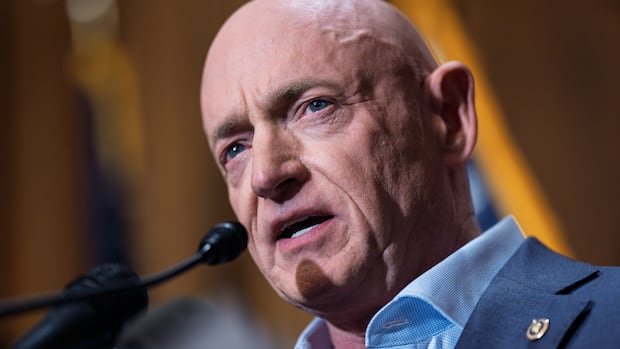

Democratic Senator Mark Kelly filed a lawsuit against the Pentagon on Monday, alleging that the Trump administration violated his free speech rights by attempting to penalize him for speaking out against unlawful orders given to U.S. troops. Kelly, a former astronaut and U.S. navy pilot representing Arizona, is challenging the censure imposed on him by U.S. Defense Secretary Pete Hegseth last week. This censure, deemed a formal but inconsequential step, could potentially lead to a demotion from Kelly’s retired captain rank and a reduction in retirement benefits.
In his legal action, Kelly petitioned the federal court in Washington, D.C., to declare the censure letter, rank proceedings, and any other punitive actions against him as unconstitutional and unlawful. The lawsuit emphasizes that the government is prohibited by the First Amendment from punishing or retaliating against protected speech, especially when it involves public policy discussions by legislators.
The rare scenario of a sitting senator suing the defense secretary is now under the jurisdiction of U.S. District Judge Richard Leon, appointed by former President George W. Bush. Kelly’s censure stemmed from his participation in a video alongside five other Democratic lawmakers in November 2025, urging troops to uphold the Constitution and resist illegal commands.
Despite facing backlash from President Trump, who labeled their message as “sedition,” Kelly and his colleagues have stood by their video. The Pentagon initiated an investigation into Kelly in late November, citing a law that allows retired service members to be called back to active duty for potential disciplinary actions. While all six lawmakers in the video have military or intelligence backgrounds, Kelly is the sole focus of the investigation due to his formal military retirement status falling within the Pentagon’s jurisdiction.
Kelly condemned Hegseth’s actions as an attempt to stifle dissent among military veterans by threatening their rank and benefits. He affirmed his commitment to defending the rights of Americans who have fought to protect freedom, asserting that such suppression of speech has no place in the United States.