
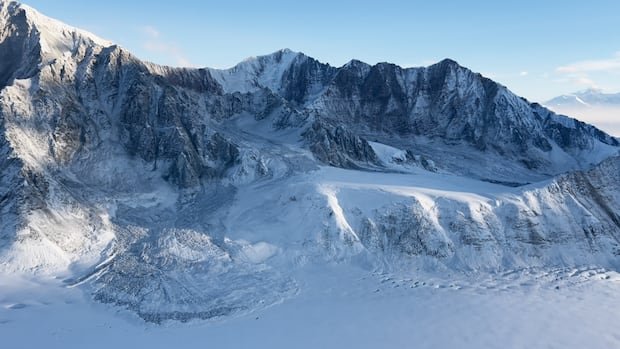

A team of researchers from the Yukon Geological Survey is conducting aerial surveys in a remote mountainous region in southwest Yukon to investigate avalanches and landslides triggered by a magnitude 7.0 earthquake that shook the area recently.
The earthquake, which occurred near the Alaska-Yukon border on Dec. 6, has provided evidence confirming the existence of a hidden fault beneath the Earth’s surface, as per geologists. This seismic event has shed light on a long-standing theory and exposed a fault that was previously unknown.
The intersection of two major plate boundary systems on Earth in the southwestern corner of the Yukon has puzzled experts like Michael West, Alaska’s state seismologist and research professor at the Alaska Earthquake Center. This unique geological configuration has been referred to as the ‘train wreck of plate tectonics’, highlighting the limited understanding of the dynamics at play in this area.
While both Alaska and the Yukon are known for their seismic activity, the recent earthquake occurred in a region that historically had not experienced significant seismic events within the past few decades. This anomaly has led researchers to speculate about a possible link between the North American plate boundary and major faults within the plate’s interior.
Jan Dettmer, the geoscience research manager at the Yukon Geological Survey, emphasized the significance of being able to directly observe the hypothesized fault for the first time since the 1960s. The discovery has garnered international interest and presents a valuable opportunity for further research.
The earthquake, which struck at 12:41 p.m. local time on Dec. 6, was most strongly felt in the communities of Burwash Landing and Haines Junction in the Yukon, with tremors reaching as far as Whitehorse, approximately 250 kilometers away. Residents like Pascale Dubois vividly recounted the intense shaking and swaying experienced during the seismic event, with fears of structural collapse running high.
Despite the unsettling experience, the earthquake had minimal impact on the Yukon population, underscoring the region’s preparedness for such natural events. Michael West highlighted the sheer magnitude of a 7.0 earthquake and its potential for catastrophic consequences in other parts of the world.
The aftermath of the earthquake is visible in the landscape of Yukon’s Kluane National Park, where researchers are studying the effects of the seismic event on the region. The ongoing aftershocks are expected to provide valuable insights into the geological processes shaping the area, particularly the active mountain-building processes.
The research conducted following the earthquake aims to map the fault lines beneath the surface, enhancing understanding of seismic activity in the area and assessing the potential risks to nearby communities. The collaborative efforts of researchers worldwide are anticipated to yield new insights and possibly identify previously unrecognized fault systems.