
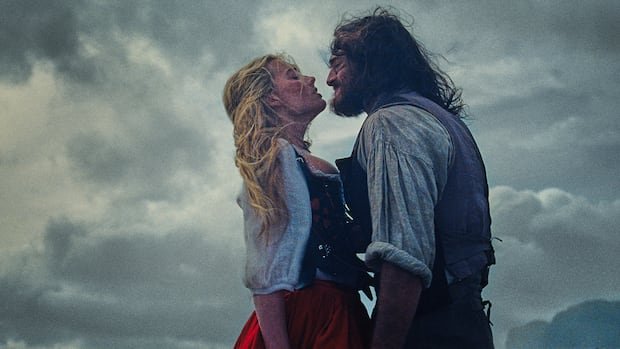

Emerald Fennell’s adaptation of Emily Brontë’s classic novel “Wuthering Heights” is making waves, and it’s not just because of the unconventional title styling. Fennell’s take on the iconic love story between Heathcliff (played by Jacob Elordi) and Catherine (portrayed by Margot Robbie) is a visually striking reimagining of a familiar tale, inspired by Fennell’s own teenage nostalgia for the book.
However, some critics argue that Fennell’s version strays too far from the original source material, missing the mark on capturing the essence of Brontë’s work. The film opens with a controversial scene not found in the book, setting a tone that diverges significantly from the novel’s original narrative.
One of the most contentious issues is the casting of Elordi, a departure from the description of Heathcliff in the book. While previous adaptations have also featured non-Black actors in the role, Fennell’s choice has sparked debate about the character’s racial identity and its significance in the story.
Fennell’s interpretation emphasizes the passionate relationship between Heathcliff and Catherine, overshadowing other crucial elements of the novel. The focus on their love story alters the pacing and structure of the plot, veering into melodramatic territory and deviating from Brontë’s intended themes.
While creative liberties in adaptations can be refreshing, Fennell’s bold reimagining of “Wuthering Heights” has polarized audiences. By prioritizing a stylized romantic narrative over the original story’s complexities, the film risks losing the depth and nuance that made Brontë’s work a timeless classic.